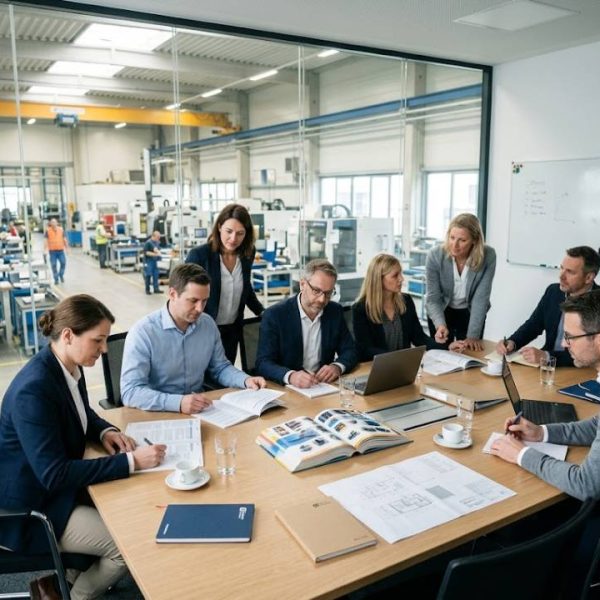
Germany's economy is famous for its Mittelstand, the thousands of family-owned and mid-sized companies that lead global niches. A firm in the Swabian Alps may make the world's best industrial valves, a company in East Westphalia might dominate a market for specialist machinery. Many of them sell more abroad than at home.
Selling internationally means communicating internationally. Contracts, offers, manuals, websites, training material and even internal emails cross language borders every day. For these companies, business translation is not a side task. It is part of how they win and keep customers.
Why business translation is different
Business texts serve a purpose. An offer must persuade, a contract must protect, a manual must instruct, a press release must inform. A translator therefore needs more than language skills. They need to understand the industry, the audience and what the text is supposed to achieve.
A good business translation reads as if it had been written in the target language by someone who knows the trade. Anything less weakens the message and, in the worst case, the company's credibility.
The documents that matter most
- Sales offers, tenders and price lists
- Contracts, terms and conditions and distribution agreements
- Product catalogues, datasheets and websites
- Annual reports, investor information and press releases
- HR documents such as policies, codes of conduct and training
- Correspondence with authorities and certification bodies abroad
Each type has its own risks. A mistake in a price list costs margin. A misunderstood clause in a contract can cost a lawsuit. A clumsy website costs leads that never arrive.
German to English, and beyond
English is the default language of international business, so most German companies start there. But English alone rarely reaches every buyer. French, Spanish, Polish, Chinese and Arabic markets often respond much better to content in their own language. International organisations such as the OECD regularly publish data on trade flows and export markets, which can help companies decide where translated content will bring the highest return.
A practical approach is to translate core documents, such as the website, main catalogue and standard contract, into the languages of the top markets first, and expand step by step.
Consistency builds trust
When a customer reads a datasheet, a quote and an invoice, the product names and technical terms should match across all three. That sounds obvious, but it often fails when several departments order translations from different suppliers. The fix is a shared terminology database and translation memory that every translator uses.
Over time, this becomes a valuable company asset. It speeds up new projects, lowers costs on repeated content and keeps the brand voice stable across languages.
Choosing the right partner
Mid-sized companies rarely have in-house translation teams. They depend on external partners, so choosing well matters. Look for specialists in your sector, a clear quality process with revision by a second linguist, data protection that meets GDPR, and a project manager who understands your deadlines.
PoliLingua provides business translation services for corporate clients, covering contracts, marketing, finance, HR and technical content in more than 200 language combinations, with dedicated project management and terminology support for long-term clients.
Working with translators effectively
Companies can do a lot to improve results. Provide editable source files, reference material and existing glossaries. Explain the target audience and the purpose of the text. Name a contact person who can answer technical questions quickly. And plan translation into project schedules from the start rather than at the last minute before a trade fair.
Payment habits deserve a place in that briefing process too. Exporters who agree terms, currencies and deadlines up front avoid the awkward chasing that strains good working relationships. Advice written for freelance translators and interpreters on invoicing promptly and stating terms clearly applies just as well on the client's side of the desk. When both sides treat billing as part of professional communication, projects finish cleanly and linguists stay available for the next urgent job.
Machine translation in a business context
Many companies already use machine translation internally, for example to understand incoming emails. For high volumes of internal documentation, machine translation with professional post-editing can be efficient. For contracts, sales material and anything customer-facing, human expertise remains the safer choice. Data security also matters: confidential documents should never be pasted into free online tools.
Interpreting for meetings and trade fairs
Written translation is only half of international communication. Negotiations, supplier audits, works council meetings with foreign staff and trade fair conversations often require interpreters. Using the same language partner for both keeps terminology aligned and saves preparation time.
Measuring the value
Translation is sometimes seen as a cost centre. Yet companies that track results usually find the opposite. Localised websites generate more enquiries, translated offers close faster, and clear manuals reduce support calls and returns. Measuring these effects market by market helps justify the budget and decide where to invest next.
Cultural details make a difference
Business etiquette varies between markets. German business writing tends to be direct and detailed. British readers often expect a softer tone, American readers a more energetic one, and French partners may value formal courtesy in letters. A translator who understands these differences adapts the tone so that a polite German email does not sound blunt or cold in another language.
The bottom line
For German exporters, language is part of the product. Professional business translation turns technical excellence into messages that customers abroad understand and trust. With the right partner and a solid terminology base, every new market becomes easier to reach.